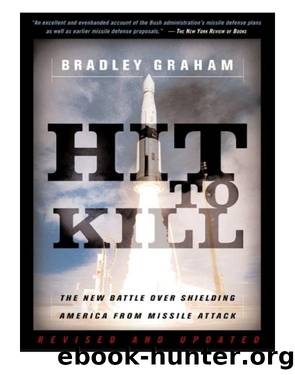
Hit to Kill by Bradley Graham
Author:Bradley Graham
Language: eng
Format: epub
Publisher: PublicAffairs
Published: 2011-05-23T00:00:00+00:00
In February 2000, the Navyâs top officer challenged Pentagon plans to rely solely on land-based interceptors to shield the United States against missile attack, urging that ship-launched interceptors also be used to knock enemy warheads out of the sky. In a confidential memo to Defense Secretary Cohen, Admiral Jay Johnson, the chief of naval operations, argued that ships would make the proposed antimissile system more effective.
This marked the first time a Navy leader formally had pushed for a role in national missile defense, although Navy authorities had argued privately for nearly a decade that ships would provide a cost-effective substituteâor at least adjunctâto basing interceptors on land. In fact, the idea of a sea-based defense had been a favorite among some of the most ardent missile defense backers. The case for such a system had been presented in a 1995 Heritage Foundation study headed by Henry Cooper, who had directed the Pentagonâs missile defense efforts in the first Bush administration.
But using interceptors aboard ships to guard U.S. skies would violate the ABM Treaty and posed all sorts of technical challenges, so the Clinton administration had done little to pursue the option. Johnson, worried that Clinton would decide on a deployment plan in the summer that would effectively preclude a Navy option, warned in his memo that such a step âwould not be in the best long-term interests of our country.â The admiral made clear he was not pressing to include sea-based interceptors in the near term, but rather in some later expansion of the antimissile project. He suggested that the sea-based option be considered as âcomplementary to, not a replacement for,â the Pentagonâs land-based scheme.
His pointed warning, which caught senior Pentagon civilians by surprise, added another controversial element to the escalating political debate over whether to construct a national interceptor system and, if so, what kind and how fast. What had prompted the Navyâs top officer, known for his reserved demeanor and nonconfrontational management style, to call into question the Pentagonâs antimissile planning? Some interpreted the move as a bid by the Navy for a piece of a major Pentagon growth program. But Johnson said the memo grew out of concern that some in the Pentagon bureaucracy, particularly on the civilian policy side, were inclined to choke off further consideration of the sea-based option. With 2000 shaping up as a pivotal year, Johnson, who had just several months remaining before retirement, felt emboldened to confront Cohen and argue the Navyâs case. He worried that if the Navy did not put down a marker before the summer, it ran the risk of being dealt out. And if that happened, getting back in the game would be all the more difficult.
Whatever money the Navy had gained just for its theater antimissile program, Johnson felt, had required a persistent struggle. The lionâs share of Pentagon funding for theater missile defense had gone toward the land-based alternative, the Armyâs THAAD program. He recalled that in his first months as chief, the Navy program was
Download
This site does not store any files on its server. We only index and link to content provided by other sites. Please contact the content providers to delete copyright contents if any and email us, we'll remove relevant links or contents immediately.
Spell It Out by David Crystal(36220)
Life for Me Ain't Been No Crystal Stair by Susan Sheehan(35894)
The Great Music City by Andrea Baker(33427)
Cecilia; Or, Memoirs of an Heiress — Volume 1 by Fanny Burney(32711)
Cecilia; Or, Memoirs of an Heiress — Volume 2 by Fanny Burney(32074)
Cecilia; Or, Memoirs of an Heiress — Volume 3 by Fanny Burney(32057)
Professional Troublemaker by Luvvie Ajayi Jones(29744)
The Secret History by Donna Tartt(19442)
We're Going to Need More Wine by Gabrielle Union(19161)
Twilight of the Idols With the Antichrist and Ecce Homo by Friedrich Nietzsche(18760)
All the Missing Girls by Megan Miranda(16637)
Cat's cradle by Kurt Vonnegut(15533)
For the Love of Europe by Rick Steves(14861)
Pimp by Iceberg Slim(14777)
Bombshells: Glamour Girls of a Lifetime by Sullivan Steve(14210)
Norse Mythology by Gaiman Neil(13547)
Talking to Strangers by Malcolm Gladwell(13518)
Fifty Shades Freed by E L James(13338)
The Social Justice Warrior Handbook by Lisa De Pasquale(12286)
